 Morphoblue
 interest rates under AdaptiveCurveIRM
Last updated:Morphoblue interest rates change with utilization as AdaptiveCurveIRM adjusts the cost of borrowing within each market. The model targets 90% utilization through immediate curve responses and adjustments over time. Suppliers receive interest after the market fee, with returns also reflecting how much lending capital borrowers use.
Borrow Quotes Before and After a State Change
A borrow quote estimates financing costs for the selected market. When a refreshed quote differs, comparing market state can explain the change before a borrower changes the loan.
Suppose a later reading shows more borrowed assets with unchanged supplied assets. Utilization has increased, so AdaptiveCurveIRM moves the borrowing rate upward along its existing curve. Rechecking the market inputs tests that explanation without changing a position.
| Comparison Stage | Comparable Market Data |
|---|---|
| Match the market | The same network and the same loan asset, collateral asset, oracle, LLTV, and IRM. |
| Align the state | The block timestamp, total borrowed and supplied assets, lastUpdate, stored rate at target, and market fee for each reading. |
| Match the rate convention | Interval-average APYs with interval-average APYs, or end-of-interval APYs with end-of-interval APYs. |
Use an updated quote when the change follows the market’s state. If otherwise matching readings disagree, align their APY conventions before comparing costs. Above-target utilization can also move the curve upward between timestamps, even without another borrow.
The Inputs Behind a Market Quote
Five fixed parameters identify a market: the loan asset, collateral asset, oracle, liquidation loan-to-value (LLTV), and IRM. A token pair alone cannot distinguish configurations with different rate models or risk settings. Market creation requires a governance-enabled IRM, and an existing market keeps its chosen address. Fixed rules still allow the model’s market-specific rate state to evolve. AdaptiveCurveIRM also uses utilization, its stored rate at target, and elapsed time since lastUpdate. Utilization measures borrowed loan assets against supplied loan assets; collateral balances do not belong in that denominator.
How Does AdaptiveCurveIRM Move Borrowing Rates?
AdaptiveCurveIRM moves borrowing rates along a utilization curve and shifts that curve over time when utilization differs from target. AdaptiveCurveIRM targets 90% utilization in markets using that model. The rate at target anchors the curve at that utilization level.
An increase in utilization raises borrowing rates along the current curve, while a decrease lowers them. This curve mechanism responds to a change in the fraction of supplied loan assets borrowers use. The curve’s current anchor determines the level from which that response starts.
Time adds a separate adjustment: when utilization exceeds target, the rate at target moves upward, shifting the whole curve. Below target, it moves downward. The model’s upper and lower bounds limit these shifts. On each side of target, a larger utilization deviation makes adaptation faster.
Adaptation continues between interactions, so unchanged utilization does not mean unchanged rates. The accumulated adjustment depends on elapsed time and utilization’s distance from target, so a rate reading needs a timestamp alongside utilization.
Two markets can have equal utilization yet different borrowing rates because their curves reflect different utilization histories. The current percentage alone does not reveal each curve’s level. Higher borrowing costs can encourage repayment, while lower costs can encourage borrowing, helping utilization move toward target. Those incentives cannot force a particular response from borrowers or suppliers.
Accrued Interest and Supplier Accounting
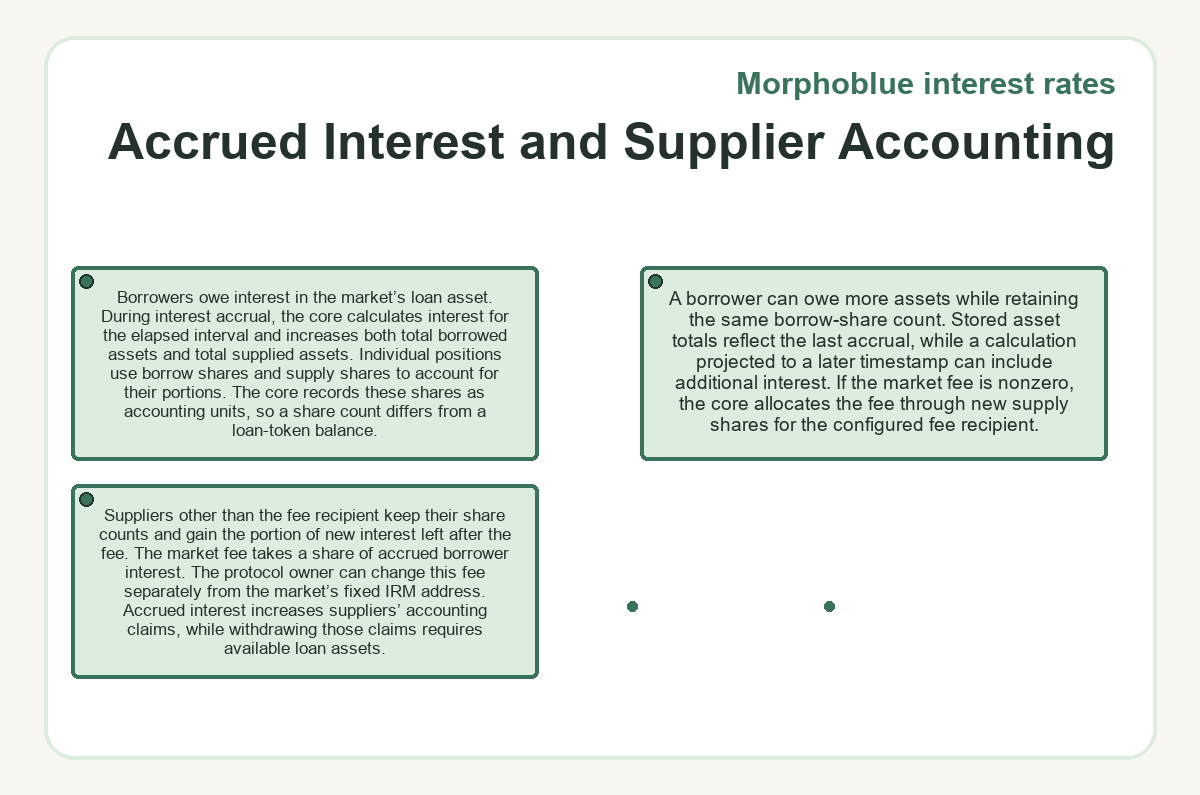
Borrowers owe interest in the market’s loan asset. During interest accrual, the core calculates interest for the elapsed interval and increases both total borrowed assets and total supplied assets. Individual positions use borrow shares and supply shares to account for their portions. The core records these shares as accounting units, so a share count differs from a loan-token balance. A borrower can owe more assets while retaining the same borrow-share count. Stored asset totals reflect the last accrual, while a calculation projected to a later timestamp can include additional interest.
If the market fee is nonzero, the core allocates the fee through new supply shares for the configured fee recipient. Suppliers other than the fee recipient keep their share counts and gain the portion of new interest left after the fee. The market fee takes a share of accrued borrower interest. The protocol owner can change this fee separately from the market’s fixed IRM address.
Accrued interest increases suppliers’ accounting claims, while withdrawing those claims requires available loan assets.
Annualizing Borrow and Supply Rates
Annual percentage yield (APY) expresses a per-second rate as an effective annual figure with compounding. Let
r
be the fractional per-second borrow rate,
u
be fractional utilization, and
f
be the fractional market fee. The annualization convention uses
T = 31 536 000 seconds
. Its formulas are
borrowAPY = exp(r × T) - 1
and
supplyAPY = exp(r × u × (1 - f) × T) - 1
.
Calculate the per-second supply rate before compounding by multiplying the borrow rate by utilization and the suppliers’ remaining interest share. Multiplying an already compounded borrow APY by those factors gives a different answer because compounding is nonlinear. Both APY expressions produce fractions; multiply by 100 when displaying percentages.
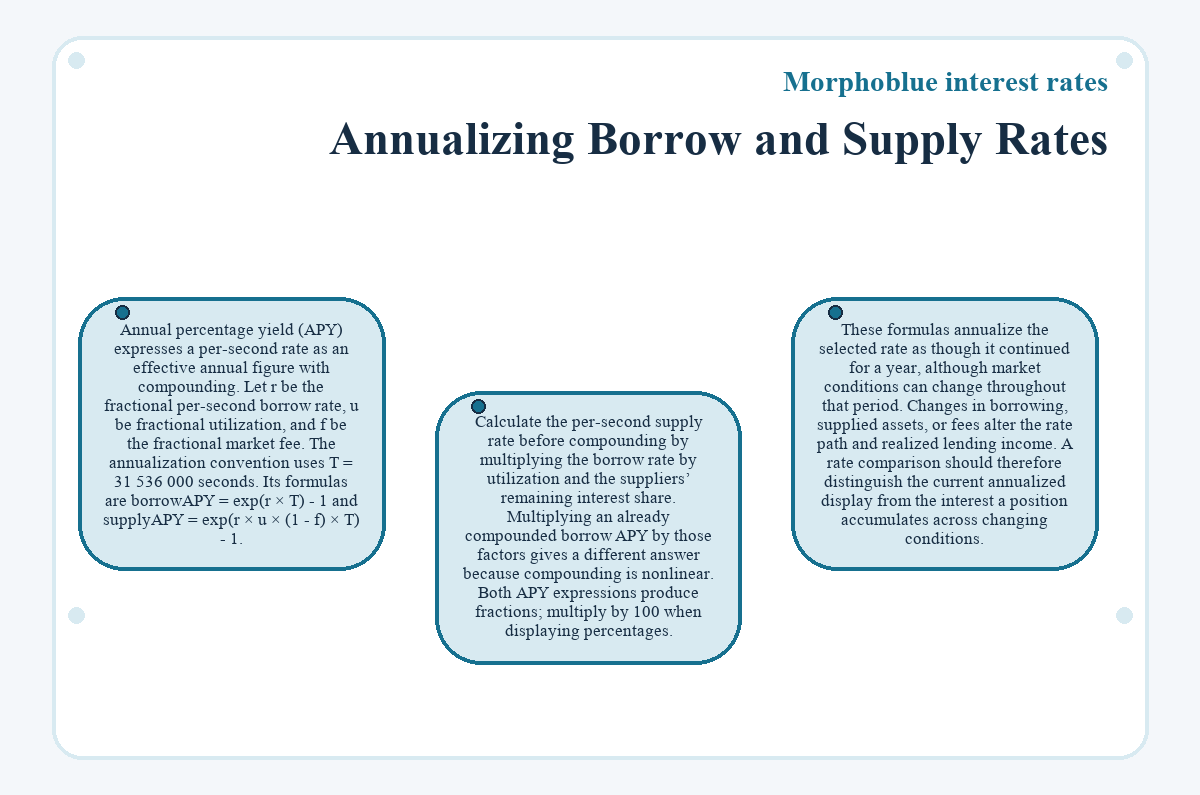
These formulas annualize the selected rate as though it continued for a year, although market conditions can change throughout that period. Changes in borrowing, supplied assets, or fees alter the rate path and realized lending income. A rate comparison should therefore distinguish the current annualized display from the interest a position accumulates across changing conditions.
Interval Averages and End-of-Interval Rates
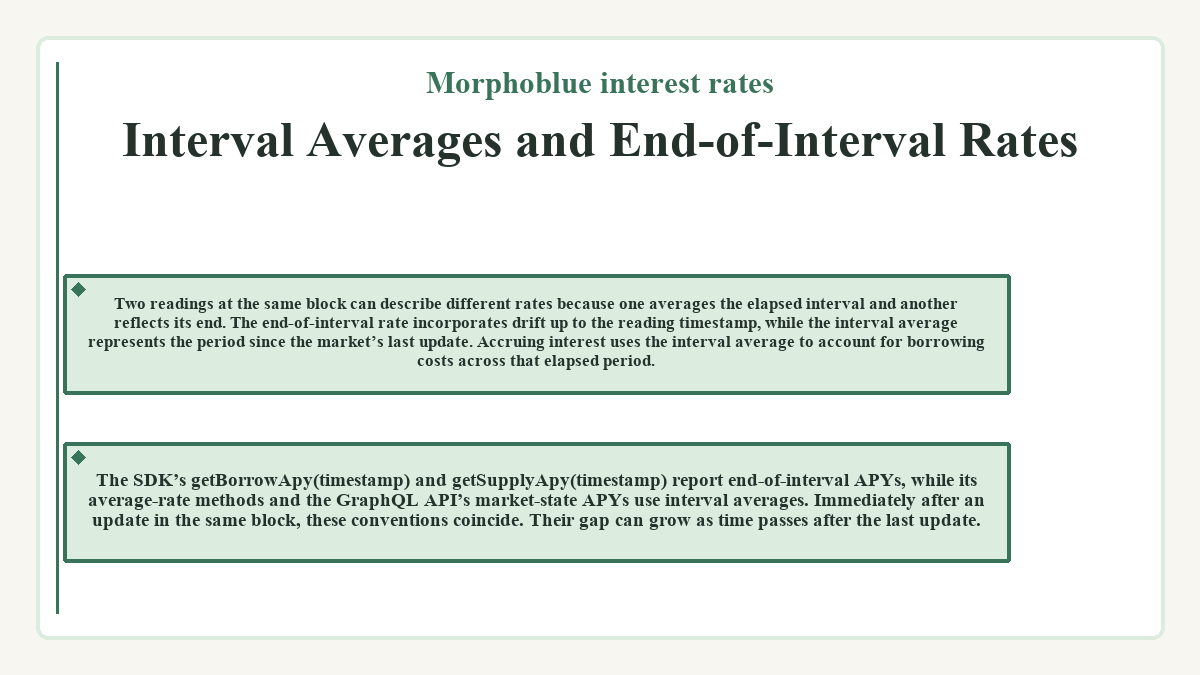
Two readings at the same block can describe different rates because one averages the elapsed interval and another reflects its end. The end-of-interval rate incorporates drift up to the reading timestamp, while the interval average represents the period since the market’s last update. Accruing interest uses the interval average to account for borrowing costs across that elapsed period.
The SDK’s
getBorrowApy(timestamp)
and
getSupplyApy(timestamp)
report end-of-interval APYs, while its average-rate methods and the GraphQL API’s market-state APYs use interval averages. Immediately after an update in the same block, these conventions coincide. Their gap can grow as time passes after the last update.
Utilization, Withdrawal Liquidity, and Debt Growth
For unchanged total supply, higher borrowing leaves fewer loan assets available for withdrawals. Interest income can rise as that available share shrinks because more lending capital supports interest-bearing loans. AdaptiveCurveIRM also raises borrowing costs when utilization increases along the curve, which can lift the supplier rate further.
Rates cannot compel repayment at a particular time, so a supplier’s withdrawal still requires enough market liquidity. Borrowers face a different consequence: accruing interest increases debt, which can raise their position’s loan-to-value even if collateral valuation remains unchanged. Crossing the market’s LLTV makes the position liquidatable. A rate movement changes financing costs; the liquidation threshold remains the market’s selected parameter.
Direct Market APY and Vault Returns
A direct market APY describes one lending market, while Morpho Vault V2 returns reflect allocations across its enabled adapters and any vault-level fees. Adapters can route assets to underlying variable-rate markets or other supported yield sources. A quoted borrow APY, a direct supply APY, and a vault return therefore measure different economic exposures. Choose the figure matching the obligation or asset position you need to evaluate, then use its actual timestamp and fee basis.
Morphoblue interest rates questions worth asking
Does Extra Collateral Lower the Borrow APY?
Extra collateral does not directly lower a market’s borrow APY because AdaptiveCurveIRM uses market utilization to determine the rate. Adding collateral can improve a borrower’s loan-to-value by increasing the collateral backing existing debt. It does not increase the supplied loan assets used in utilization. Any later borrowing changes debt and utilization separately, so the collateral addition and the borrowing action have different rate effects.
When Does accrueInterest Transfer Loan Tokens?
Calling the native accrueInterest function does not itself transfer loan tokens. For an AdaptiveCurveIRM market, elapsed interest changes accounted debt and supply assets, including applicable fee-share accounting. A call with zero elapsed time returns without updating interest. Repayment and withdrawal move loan assets through their own operations, so an accrual call does not deliver newly earned tokens to a supplier’s wallet.
Why Can an API Supply APY Differ From a Recalculation Using API Totals?
The API combines an interval-average APY with totals accrued to its state block. Recomputing utilization from those accrued totals does not exactly reproduce the inputs behind its supplyApy field. To reproduce that field with the SDK, use getAvgSupplyApy(timestamp) at the state block’s timestamp on the market as last stored onchain. A copy with interest already accrued changes the calculation basis.
Can a Native Flash Loan Accrue the market’s Variable Borrow Interest?
A native flash loan uses separate repayment mechanics and charges no variable borrow interest. The caller returns the borrowed token amount within the same transaction, and the native flash loan charges no protocol fee. Network execution still costs gas. If custom logic also opens a collateralized borrowing position, that separate position follows its market’s variable interest rules.
How Should I Decode the Raw Market Fee?
The raw market fee uses WAD scaling with 18 decimals. Divide the stored value by 10^18 to obtain the fractional fee used in the supply-rate formula, then multiply that fraction by 100 to express it as a percentage. This field describes the market’s share of borrower interest. It does not represent a deduction of the same percentage from the whole supplied balance.
What Fee Applies When Governance Changes It Between Interest Updates?
The core accrues the elapsed interval using the previous fee before storing a new market fee. The setFee operation preserves the old fee for interest due up to that update. Later accrual uses the new setting. Fee changes therefore do not apply the new percentage retroactively to the entire interval since the previous update, and they do not replace the market’s IRM.
Which Rate Does AdaptiveCurveIRM’s borrowRateView Return?
AdaptiveCurveIRM’s borrowRateView returns the interval-average borrow rate from lastUpdate to the queried block time. It returns a rate rather than an APY. The SDK’s end-of-interval APY methods use a different convention, so annualizing borrowRateView does not necessarily reproduce those methods after time has elapsed. Compare it with an average-rate APY calculation when matching the same interval.