 Morphoblue
 liquidations require a borrower’s LTV to exceed the market’s fixed LLTV
Last updated:Morphoblue liquidations let anyone repay an eligible borrower’s debt in exchange for discounted collateral. Eligibility starts when loan-to-value (LTV) exceeds the market’s fixed liquidation loan-to-value (LLTV), using accrued debt and the market oracle’s collateral valuation. Crossing the threshold permits liquidation; an external caller must still execute it. Successful execution reduces debt and collateral, while collateral exhaustion can leave a loss for lenders in that market.
In short: A partial liquidation can leave a borrower eligible for another liquidation if remaining debt still exceeds the collateral-based borrowing limit.
The Borrower, Oracle, and Liquidator
A liquidation targets a borrower within one market, using its loan token, collateral token, oracle, and LLTV. The core also uses the market’s interest rate model to accrue debt before checking eligibility. The borrower’s loan-token debt and posted collateral form the balances the core evaluates. Only collateral recorded for the selected borrowing position enters its borrowing limit. The liquidator supplies the loan tokens required for the repayment and receives the collateral the core computes.
Permissionless liquidation does not require the borrower’s authorization. The caller must still satisfy the selected market’s repayment and token requirements.
When Does a Borrowing Position Become Liquidatable?
A position becomes liquidatable when accrued debt exceeds the borrowing limit its collateral supports under the market’s LLTV. The oracle determines collateral value in loan-token units. An external trading price does not directly replace the price the configured oracle returns.
Accrued debt D and oracle-valued collateral V must use the same loan-token units. For positive V, LTV = D / V. The conceptual liquidation condition is D > V × LLTV, with LLTV expressed as a fraction.
The market’s LLTV stays fixed while falling collateral value or accruing borrowing interest can trigger liquidation without another borrowing transaction.
The core converts borrow shares into loan assets with upward rounding. It rounds collateral valuation and the LLTV-adjusted limit downward. Equality with that integer limit remains healthy. A rounded screen percentage can therefore conceal the precise comparison the contract performs.
Repayment or Additional Collateral Before Liquidation
Debt repayment and additional collateral offer different ways to address the same unhealthy position. Repayment requires the market’s loan token; adding collateral requires its collateral token. Both aim to bring accrued debt within the oracle-priced borrowing limit. A submitted transaction does not protect the position while execution remains pending.
- Compare available loan tokens for repayment with available tokens matching the market’s collateral asset.
- Calculate whether repayment or additional collateral would satisfy the current borrowing limit, including accrued interest.
- Choose the funded option and provide the allowance the core needs to collect its tokens.
- If funding or allowance is missing, correct that dependency or use the other compatible asset path.
- Execute the repayment or collateral supply, then confirm success and check the updated debt-to-collateral relationship; a still-unhealthy position remains liquidatable.
A failed token transfer reverts the attempted change, leaving the position liquidatable if its debt still exceeds the limit. Adding collateral also skips interest accrual in the core, so unchanged stored debt does not establish its current health.
Collateral Seizure and the Liquidation Incentive
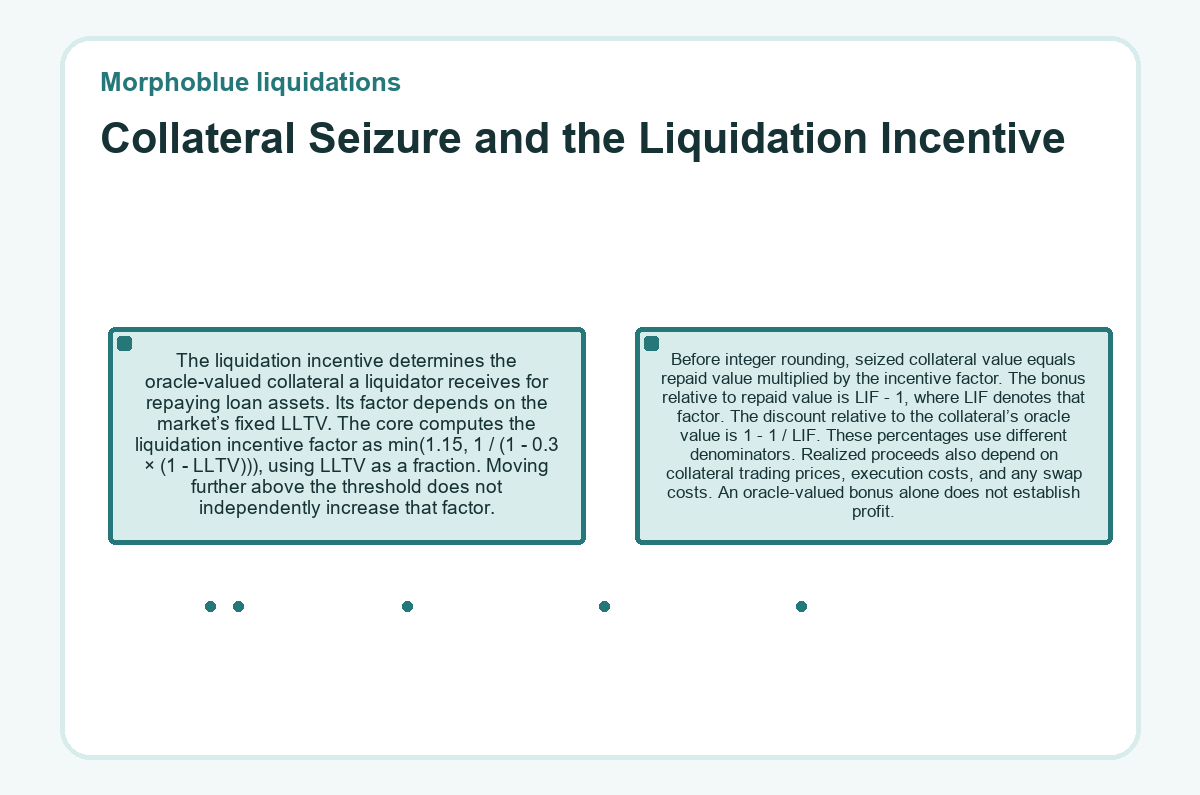
The liquidation incentive determines the oracle-valued collateral a liquidator receives for repaying loan assets. Its factor depends on the market’s fixed LLTV. The core computes the liquidation incentive factor as min(1.15, 1 / (1 - 0.3 × (1 - LLTV))), using LLTV as a fraction. Moving further above the threshold does not independently increase that factor.
Before integer rounding, seized collateral value equals repaid value multiplied by the incentive factor. The bonus relative to repaid value is LIF - 1, where LIF denotes that factor. The discount relative to the collateral’s oracle value is 1 - 1 / LIF. These percentages use different denominators. Realized proceeds also depend on collateral trading prices, execution costs, and any swap costs. An oracle-valued bonus alone does not establish profit.
Can a Liquidator Close the Entire Debt?
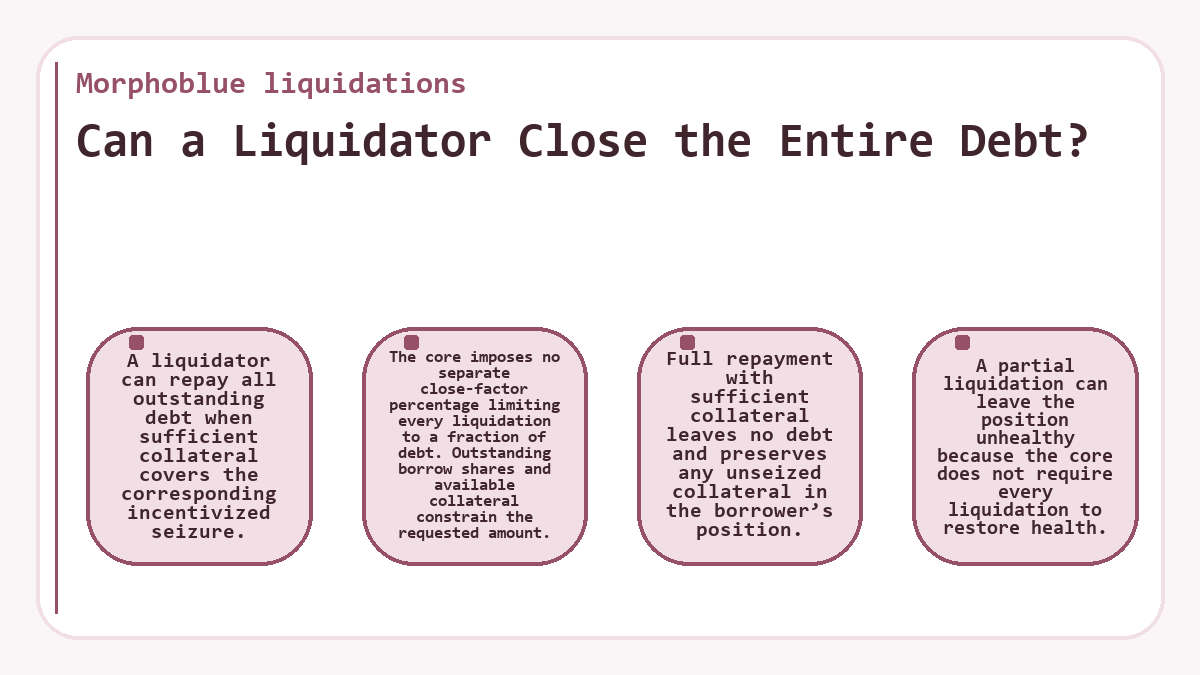
A liquidator can repay all outstanding debt when sufficient collateral covers the corresponding incentivized seizure. The core imposes no separate close-factor percentage limiting every liquidation to a fraction of debt. Outstanding borrow shares and available collateral constrain the requested amount. Full repayment with sufficient collateral leaves no debt and preserves any unseized collateral in the borrower’s position.
A partial liquidation can leave the position unhealthy because the core does not require every liquidation to restore health.
Settlement Through Tokens and Optional Callbacks
Liquidation settlement transfers collateral before pulling the loan tokens the liquidator owes. The core updates debt and collateral accounting, transfers the computed seizure, optionally invokes
onMorphoLiquidate
, and collects
repaidAssets
from the caller. A callback can use received collateral in its own funding logic. The calling contract must have the required loan-token balance and allowance before the core collects repayment.
A reverted liquidation undoes its debt changes and collateral transfer. An included transaction still incurs costs for execution work even when it reverts.
Bad Debt and Losses Within the Market
Collateral exhaustion creates a separate accounting outcome when debt remains after the incentivized seizure. The core converts the remaining borrow shares into bad debt, reduces that market’s total borrowed and supplied assets, and clears the borrower’s remaining debt shares. Lenders absorb the reduction through their supply positions. A vault allocating to the affected market also carries exposure through its underlying position. The core accounts for this loss within the affected market; it does not deduct it from unrelated markets’ supplied balances.
Repayment recovers loan tokens, while clearing residual shares through bad-debt accounting recognizes a loss for the market’s lenders.
Collateral Amounts and Debt Shares as Liquidation Inputs
Native liquidation sizing accepts either collateral units through
seizedAssets
or debt shares through
repaidShares
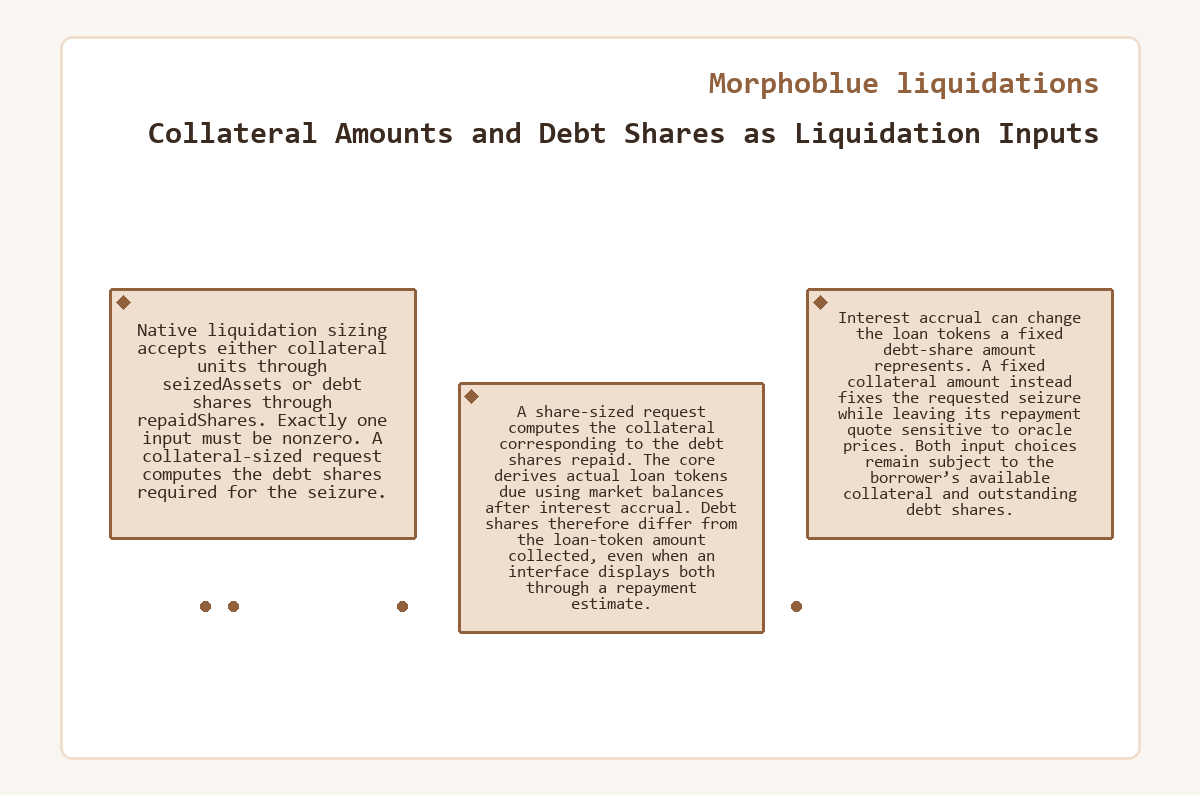
. Exactly one input must be nonzero. A collateral-sized request computes the debt shares required for the seizure. A share-sized request computes the collateral corresponding to the debt shares repaid. The core derives actual loan tokens due using market balances after interest accrual. Debt shares therefore differ from the loan-token amount collected, even when an interface displays both through a repayment estimate.
Interest accrual can change the loan tokens a fixed debt-share amount represents. A fixed collateral amount instead fixes the requested seizure while leaving its repayment quote sensitive to oracle prices. Both input choices remain subject to the borrower’s available collateral and outstanding debt shares.
What to know about Morphoblue liquidations
Why Can a Morphoblue Liquidation Revert After a Competing Repayment?
A competing repayment can leave fewer borrow shares outstanding than your liquidation tries to remove. The core checks health against execution-time state, then subtracts the requested or computed repayment shares. If another repayment restores health, the health check rejects liquidation. If the position remains unhealthy but the request exceeds its remaining debt shares, subtraction can revert for underflow.
Can a Liquidator Name a Different Collateral Receiver?
The native liquidation function sends seized collateral to its caller and has no separate receiver parameter. A contract calling the core can implement an onward transfer through its own logic. The borrower parameter identifies the position undergoing liquidation; it does not designate where the collateral goes.
Will Empty Callback Data Stop a Liquidation?
Empty data skips onMorphoLiquidate while leaving native liquidation available. The core invokes that optional callback only when data is nonempty. A caller using empty data must have sufficient loan tokens and a valid allowance for the final pull. Empty data does not relax the health check or the debt and collateral balance limits.
Does the Market Interest Fee Reduce a Liquidator’s Collateral?
The native liquidation function does not take a separate interest-fee cut from seized collateral. Any market interest fee applies during interest accrual. The liquidation incentive determines the collateral exchange, and the core transfers the computed seizedAssets to the caller. Transaction execution and any external swaps can create other costs.
Could an Oracle Failure Block a Liquidation?
An oracle failure can block liquidation if the market’s configured price() call reverts. The core needs that result before evaluating health and calculating collateral seizure. A falling price visible elsewhere cannot replace the return value the core requires. The oracle address remains one of the selected market’s fixed parameters.
How Do Token Decimals Affect the Collateral Calculation?
Liquidation calculations convert collateral base units into loan-token base units using the market oracle’s scaling. For the health check, the core multiplies raw collateral units by price(), divides by 10^36, and rounds down. When a liquidation specifies the collateral amount to seize, the core rounds that amount’s loan-token valuation up when calculating repayment. Token decimal differences affect the oracle’s scaling, so a displayed whole-token price cannot automatically substitute for its raw return value. Incorrect unit conversions can misstate eligibility and seizure amounts.
What Does a Successful Liquidate Event Record?
A successful transaction’s Liquidate event records the market, liquidator, borrower, repayment amounts, seized collateral, and any bad debt. Its repaidAssets and repaidShares fields measure different quantities. The badDebtAssets field identifies debt written off, rather than additional repayment collected from the liquidator. Remaining debt and collateral belong to the updated position state.
Is Unseized Collateral Automatically Returned When Liquidation Clears the Debt?
Unseized collateral remains in the borrower’s market position after liquidation clears the debt. The liquidation function transfers only the computed seizure. With no debt remaining, the borrower or an authorized operator can use withdrawCollateral to withdraw the remainder, subject to the token transfer succeeding. Clearing debt does not execute that withdrawal automatically.