 Morphoblue
 connects lenders and borrowers through isolated lending markets
Last updated:Morphoblue pairs one collateral asset with one loan asset in each isolated lending market. Lenders supply the loan asset to earn interest, while borrowers provide collateral to access it. Each market fixes its assets, oracle, interest rate model, and liquidation threshold at creation. Lending returns vary, and lenders need sufficient market liquidity to withdraw their assets.
Depositing loan assets and posting collateral create different positions with different constraints. The selected market determines those relationships. Direct participation offers control over market selection, while curated vaults can handle allocation through a separate layer of contracts.
Collateral valuations and accrued debt can change a position’s borrowing capacity even when its market parameters remain fixed.
Can You Lend Without Posting Collateral?
You can lend without posting collateral because collateral requirements apply to borrowing, while lenders supply the loan asset. A direct lending position exposes its owner to one selected market. Borrowers pay interest on outstanding loans, and suppliers receive the portion attributable to their lending positions after any applicable market fee.
The lender chooses exposure to a particular collateral asset, oracle, and liquidation threshold through that market selection. Supplying the same loan token elsewhere can involve different collateral and valuation dependencies. Lending also leaves capital subject to borrower demand: the interest calculation and the availability of funds for withdrawal both reflect the market’s borrowing activity.
The Five Parameters Behind Each Market
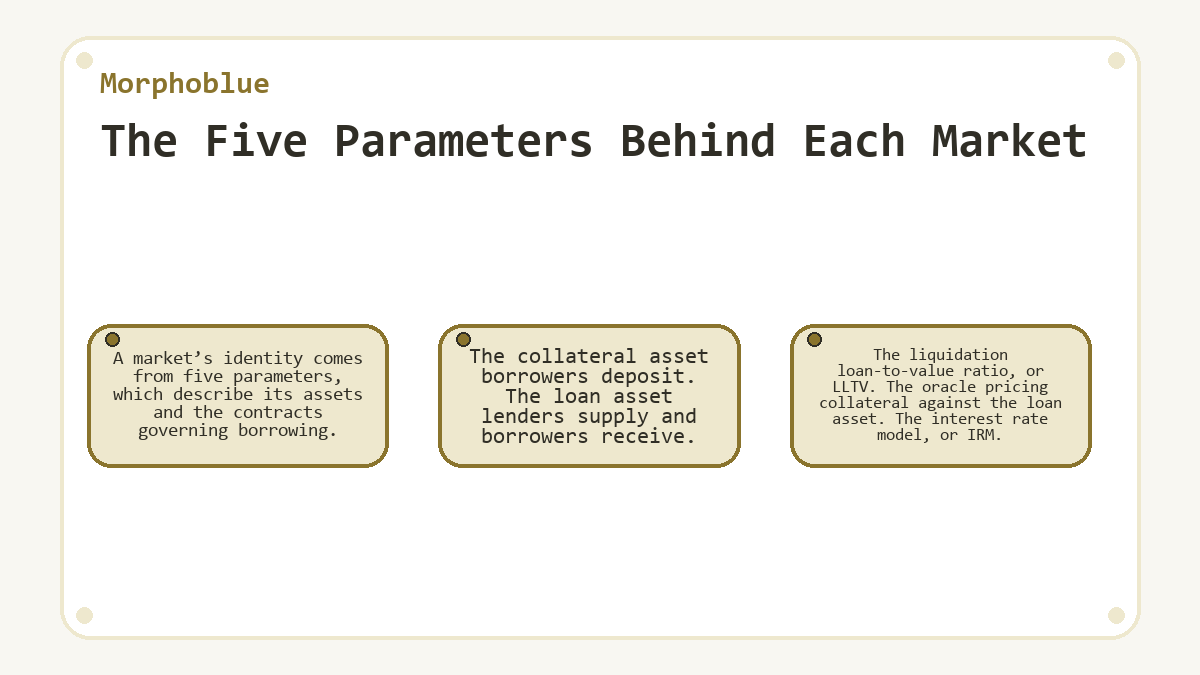
A market’s identity comes from five parameters, which describe its assets and the contracts governing borrowing.
- The collateral asset borrowers deposit.
- The loan asset lenders supply and borrowers receive.
- The liquidation loan-to-value ratio, or LLTV.
- The oracle pricing collateral against the loan asset.
- The interest rate model, or IRM.
Assets and Valuation
The collateral token backs borrowing, and the loan token denominates the debt. The oracle supplies their valuation relationship. A borrowing limit therefore uses collateral value expressed in units of the loan asset. Raw token counts alone do not establish equivalent economic value.
Borrowing Rules
Liquidation Threshold
The LLTV sets the maximum debt relative to oracle-valued collateral before a position becomes liquidatable. It describes a borrowing boundary, not an interest rate. When a position’s loan-to-value ratio exceeds the LLTV, anyone can liquidate it by repaying a portion of its debt in exchange for discounted collateral.
Interest Rate Model
The IRM supplies the formula determining borrower interest. Fixing its contract address preserves the chosen model while allowing its calculated rate to change.
Borrowing Against Collateral
Borrowers provide the selected market’s collateral asset before drawing its loan asset. Their borrowing capacity depends on collateral valuation, outstanding debt, and the LLTV. Actual access to a loan also requires available loan-asset liquidity. An acceptable collateral ratio cannot create liquidity when the market lacks funds.
Collateral stays outside the market’s regular loan supply: collateral deposits do not finance ordinary collateralized loans to other borrowers. A collateral deposit therefore has a different function from an interest-earning supply of loan assets. The borrower keeps exposure to the collateral asset while taking on debt denominated in the loan asset, with the oracle connecting their values.
Variable Interest and Market Fees
Interest rates follow the selected model and market conditions, so a fixed market configuration does not lock a borrowing rate. AdaptiveCurveIRM adjusts rates in response to utilization, the proportion of supplied loan assets borrowers have borrowed. Its adaptation can change borrowing costs over time even though the market continues using the same model.
Supply yield reflects how much lending capital earns borrower interest, together with any market fee. When active, that fee takes a share of accrued borrower interest. Governance can change the fee separately from the market’s defining parameters. A displayed annualized yield describes a rate calculation; it does not establish the interest a lender will receive over a future year.
A Fixed Threshold With a Changing Collateral Value
A hypothetical borrowing position shows how an unchanged LLTV can coexist with changing liquidation risk. Assume a market uses the 86% LLTV option, collateral initially has an oracle value of 1 246 loan-asset units, and total debt including accrued interest is 996 units. The debt stays unchanged during this comparison.
The initial loan-to-value ratio is 996 divided by 1 246, or approximately 79.94%. The position falls below its 86% LLTV. If the collateral’s oracle value falls to 1 146 loan-asset units, the ratio becomes approximately 86.91%. The position now exceeds the threshold and becomes eligible for liquidation.
The market has kept its original borrowing rule throughout this change. The changing collateral valuation moves the position across it. In an actual position, accrued interest can also increase debt, so price movements are only one input affecting the ratio.
When Can You Withdraw From a Market?
Lenders can withdraw their supplied loan assets and accrued interest when the selected market has enough available liquidity. A lending balance represents a claim on market assets, including assets currently on loan. The outstanding balance alone does not establish how much the market can immediately return.
Borrower collateral withdrawals require the remaining position to pass the collateral health check. Repayment reduces the debt the collateral supports. Full repayment removes the debt-related restriction on reclaiming all collateral, while a borrower with outstanding debt can withdraw only an amount leaving the position healthy. The core does not lend this collateral onward through ordinary collateralized loans, so the constraint differs from a lender’s available-liquidity requirement.
Risk Isolation and Shared Dependencies
Isolation separates each market’s lending exposure from the debt accounting of other markets. A market’s five defining parameters cannot change after its creation. Those fixed choices make the exposure identifiable, although they do not protect against changes in the assets or dependencies themselves.
Oracle failures can distort collateral valuation and affect borrowing or liquidation decisions. An oracle’s price-update process and resistance to manipulation matter because the protocol uses its reported value. Several markets can depend on the same oracle or asset, allowing a common dependency to affect otherwise separate markets.
Token controls create another dependency. An asset issuer or administrator with freezing powers can interfere with transfers. Sharp collateral price declines can also leave debt insufficiently covered before liquidation completes. Lenders remain exposed to that shortfall within the affected market.
The shared core contract introduces protocol-level smart contract risk alongside individual market risks. Audits and formal verification examine that code, but a market’s isolation does not establish that every dependency or interaction is safe. A vault introduces additional contracts and allocation controls.
Permissionless Creation Within Governance Limits
Anyone can create a market without obtaining a governance vote for that individual market. The creator selects its assets and oracle, then chooses an LLTV and IRM from the enabled options. Governance controls which LLTVs and interest rate models the protocol permits for creation.
Creating a market does not supply lender capital or demonstrate demand for borrowing. Compatible assets, a suitable oracle, and available liquidity still determine whether the resulting market can serve a particular lending use. Changing one of those defining choices requires a different market.
Direct Supply and Curated Vault Allocations
Direct supply gives the lender responsibility for choosing an individual market. Curated vaults add contracts that can allocate deposited capital to underlying lending positions. This changes who selects and adjusts allocations without changing the defining parameters of each underlying market.
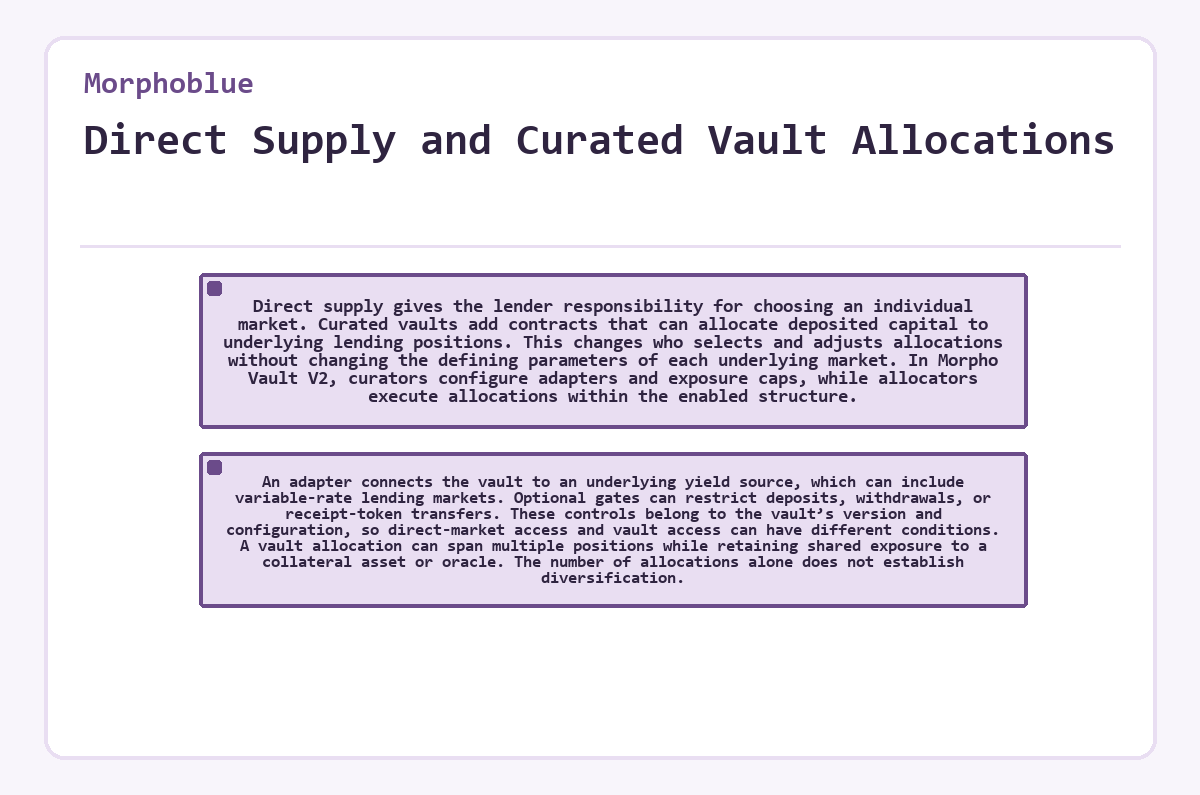
In Morpho Vault V2, curators configure adapters and exposure caps, while allocators execute allocations within the enabled structure. An adapter connects the vault to an underlying yield source, which can include variable-rate lending markets. Optional gates can restrict deposits, withdrawals, or receipt-token transfers. These controls belong to the vault’s version and configuration, so direct-market access and vault access can have different conditions.
A vault allocation can span multiple positions while retaining shared exposure to a collateral asset or oracle. The number of allocations alone does not establish diversification.
Shared Execution and Developer Building Blocks
The core groups its markets in one contract within a deployment, while maintaining separate market accounting. The contract does not support upgrades. This singleton design gives integrations access to a common execution layer. Callbacks let contracts combine supported actions with their own logic, including liquidation operations, without requiring a flash loan for every combination.
Flash loans provide another building block: the core transfers the requested token amount and requires repayment within the same transaction. The core charges no flash-loan fee. Blockchain execution still consumes gas, so the absence of that protocol fee does not make execution costless. Failure to repay within that transaction causes it to revert.
Transaction costs depend on the network and executed operations. The architecture does not establish a fixed currency cost or a universal saving across every integration.
Morphoblue and the Earlier Morpho Optimizer
The original Morpho Optimizer architecture relied on lending pools in Aave and Compound. Morphoblue introduced its own isolated lending primitive, separating the core borrowing rules from additional risk-management layers. The two architectures have different dependencies despite sharing the broader Morpho name.
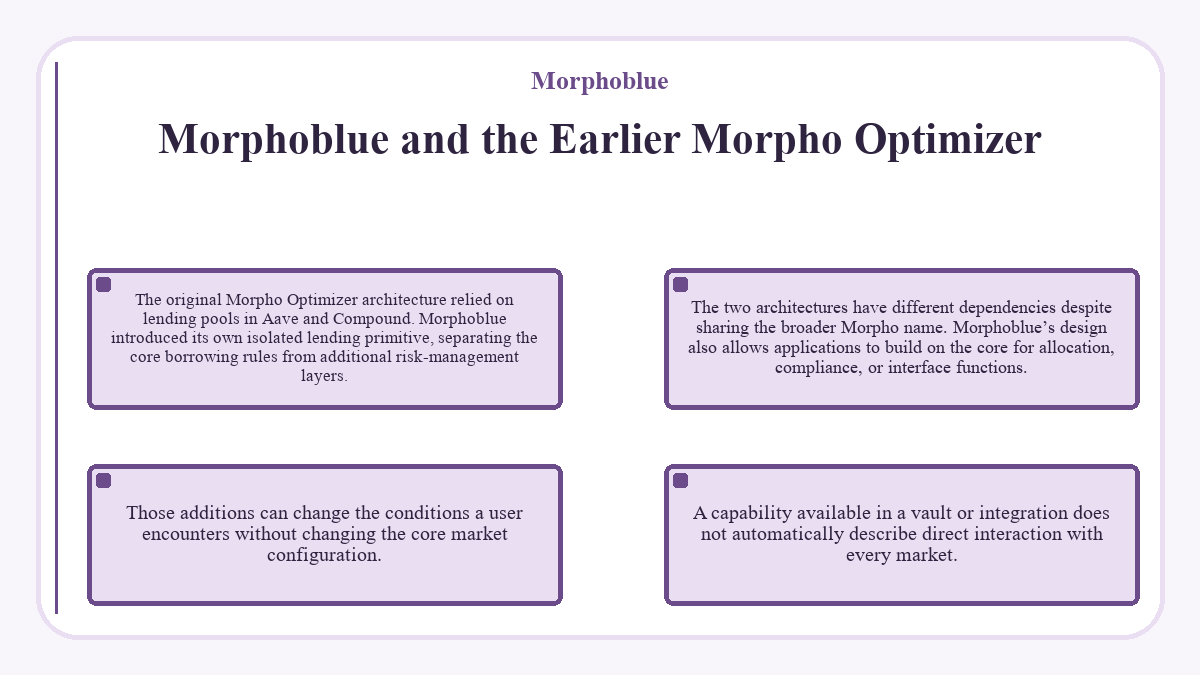
Morphoblue’s design also allows applications to build on the core for allocation, compliance, or interface functions. Those additions can change the conditions a user encounters without changing the core market configuration. A capability available in a vault or integration does not automatically describe direct interaction with every market.
Morphoblue - common questions
How Do I Read a Market Label With Two Assets and a Percentage?
In the Morpho apps, a market label lists the loan asset first, the collateral asset second, and the LLTV percentage in parentheses. It identifies what lenders supply, what borrowers pledge, and the liquidation threshold. The oracle and interest rate model addresses appear separately on the market page, so the label alone does not disclose every parameter.
Are Tokens That Charge Transfer Fees Compatible?
Tokens that deduct a fee during transfer do not satisfy the core protocol’s token requirements. The core expects transfers to change sender and recipient balances by the specified amount. ERC-20 labeling alone does not establish compatibility with those assumptions; the token’s actual transfer behavior matters.
How Can Another Contract Manage a Position?
An account can authorize another address to manage its positions across all markets in the same protocol deployment through the protocol’s authorization mechanism. This permission differs from an ERC-20 spending allowance. A contract acting for the account needs the relevant protocol authorization for borrowing or withdrawals, in addition to any token permissions its operations require.
What Happens to Debt After Liquidation Exhausts the Collateral?
The core writes off a borrower’s remaining uncovered debt when liquidation leaves that position without collateral. This reduces the affected market’s total borrowed assets and total supplied assets. Lenders in that market consequently bear the shortfall through their supply positions; market isolation does not provide reimbursement.
Does Collateral in Another Market Support an Existing Loan?
Collateral in a separate market does not count toward the existing loan’s collateral health check. The core evaluates the borrowing position within its own market and uses that market’s oracle and LLTV. An account can therefore have collateral elsewhere while a particular borrowing position remains insufficiently collateralized.
Is Borrowing Possible When a Market Uses a Zero LLTV?
A zero LLTV provides no positive collateral-backed borrowing capacity under the core health calculation. Multiplying collateral value by zero leaves no value against which to support debt. This parameter concerns the borrowing threshold, so it should not be interpreted as a zero interest rate or a general fee setting.
Can the Oracle Change How It Values Collateral?
An immutable oracle address does not make every underlying pricing dependency immutable. The chosen oracle can depend on price feeds, update processes, or administrative controls with their own behavior. Its reported price can change even though the market keeps calling the same oracle contract, directly affecting collateral valuation.
Which License Applies to the Protocol Code?
The core repository uses GPL-2.0-or-later. The release announcement dated 11 October 2023 described Business Source License 1.1, with conversion after two years or earlier activation of the protocol fee switch.